Frequently Asked Questions
The most-asked questions about seas and oceans.
What's the actual difference between a sea and an ocean?
Oceans are the vast, open bodies of salt water that surround continents, while seas are typically smaller, partially enclosed by land or other water bodies. In practice the boundary is somewhat fluid, but size, depth, and degree of enclosure are the usual distinguishing factors.
How many oceans are officially recognized, and what are they?
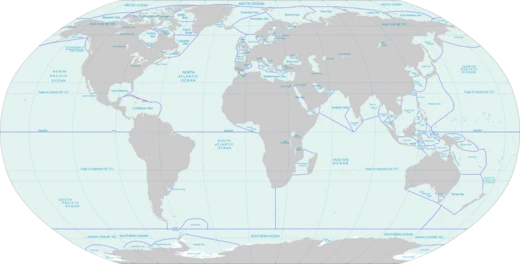
Most modern geographic authorities recognize five oceans: Pacific, Atlantic, Indian, Southern (Antarctic), and Arctic. Some older or regional systems group them into four by folding the Southern Ocean into the others, but the five-ocean model is now the most widely taught.
What is the single deepest point in the global ocean?
The Challenger Deep in the Mariana Trench, located in the western Pacific near the Mariana Islands, reaches roughly 10,935 metres below sea level. No crewed vehicle has visited it more than a handful of times, making it one of the least-explored places on Earth.
Which ocean is the largest, and how does it compare to the others?
The Pacific Ocean covers about 165 million square kilometres, roughly 30 percent of the planet's surface and more area than all land combined. The Atlantic and Indian Oceans are the next largest, while the Arctic is the smallest and shallowest.
What percentage of Earth's surface do seas and oceans cover?
About 71 percent of the planet is covered by water, and nearly all of that is salt water in the oceans and their marginal seas. Freshwater lakes, rivers, and glaciers make up only a tiny fraction of the remaining 29 percent of land and surface water.
Who are the key historical figures most associated with ocean exploration?
Names like James Cook, Ferdinand Magellan, and Jacques Cousteau are the most frequently cited, representing the eras of circumnavigation, early Pacific charting, and modern underwater science respectively. More recently, explorers such as Victor Vescovo have returned to the deepest trenches in the twenty-first century.
What are the major surface currents that shape global climate?
The Gulf Stream, Kuroshio, Antarctic Circumpolar Current, and the North and South Equatorial Currents form the backbone of the thermohaline circulation that redistributes heat around the globe. These currents influence weather patterns, marine ecosystems, and even the timing of seasonal shifts on every continent.
Which sea is the saltiest, and why?
The Dead Sea between Jordan and Israel has a salinity of roughly 34 percent, far above the ocean average of about 3.5 percent. Its extreme saltiness comes from being a landlocked basin with no outlet, so water evaporates while dissolved minerals remain and concentrate over millennia.
Where should a complete beginner start to understand oceans and seas?
A good entry point is learning the five-ocean framework, then studying one major current system and one deep-sea feature (like the Mid-Atlantic Ridge or the Mariana Trench) to build spatial intuition. From there, branching into marine biology, ocean chemistry, or human history of seafaring keeps the learning engaging.
What is a commonly cited 'wow' fact that surprises people about the oceans?
Humans have better detailed maps of the surface of Mars than of the ocean floor on our own planet. An estimated 80 percent of the seafloor remains unmapped in high resolution, and the majority of ocean species have never been identified by science.