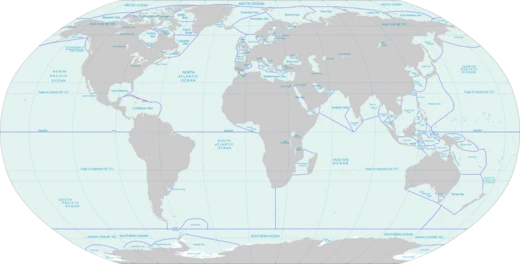
Sea of Japan
Marginal sea between Japan, Korea, Russia, and Sakhalin.
The Sea of Japan is a marginal sea located between the Japanese archipelago, Sakhalin, the Korean Peninsula, and the Russian Far East. It is notable for its near-complete enclosure from the Pacific Ocean, which results in minimal tides, lower salinity, and reduced faunal diversity compared to the open ocean. The sea has been a subject of international naming disputes and has significant economic importance due to its high biological productivity and fishing industry.
Lore & Background
The Sea of Japan was landlocked when the land bridge of East Asia existed. The Japan Arc started to form in the Early Miocene, and the sea began to open during that period, with the northern and southern parts of the Japanese archipelago separating from each other. During the Miocene, the sea expanded. The north part of the Japanese archipelago was further fragmented later until orogenesis began in the later Late Miocene.
Reader's Guide
The Sea of Japan is a marginal sea nearly enclosed by the Japanese archipelago, Sakhalin, the Korean Peninsula, and the Russian Far East. This isolation results in almost no tides, lower salinity, and reduced faunal diversity compared to the open ocean. Its water balance is governed by inflow and outflow through connecting straits, as few rivers contribute to its waters. The sea has high dissolved oxygen levels, leading to substantial biological productivity and making fishing the dominant economic activity. Historically, the sea protected Japan from land invasions, notably by the Mongols. European and Russian explorers mapped its coasts and islands from the 18th century onward, with expeditions documenting surface temperatures, tides, and cyclonal currents. In the 19th century, American, Canadian, and French whaling ships hunted right and humpback whales here, with peak activity in the late 1840s. The sea’s eastern margin may contain an incipient subduction zone, linked to several large earthquakes in the 20th century. Shipping intensity has been moderate due to political issues but is rising with East Asian economic growth.
Did You Know?
- The Sea of Japan has almost no tides due to its nearly complete enclosure from the Pacific Ocean.
- Few rivers discharge into the sea, contributing less than 1% to water exchange.
- The Tsushima Strait is one of the sea's key connections to the Pacific, having opened during the Early Miocene, around 20 million years ago.
Frequently Asked Questions
Who is Sea of Japan?
The Sea of Japan is a nearly enclosed marginal sea sitting between the Japanese archipelago, the Korean Peninsula, Sakhalin, and the Russian Far East. It links to the Pacific Ocean only through a handful of narrow straits, which sets it apart from most open-ocean bodies of water.
What are Sea of Japan's powers/role?
Its near-total land enclosure produces remarkably small tides, lower-than-average salinity, and reduced marine species diversity compared to the open ocean. Paradoxically, those same conditions drive exceptional biological productivity, making it one of the globe's richest commercial fishing grounds.
Why is Sea of Japan important?
Its highly productive waters sustain major fisheries that are economically vital to Japan, South Korea, and Russia. It also remains a persistent flashpoint in international naming disputes among those neighboring states.
What is Sea of Japan's biggest ongoing conflict?
The sea's official name is contested: Japan and South Korea consistently use "Sea of Japan," while North Korea and, in some diplomatic contexts, Russia prefer the term "East Sea." The disagreement has resurfaced in UN cartography, trade documents, and regional diplomacy for decades.
More in Seas And Oceans 1-24
Spotted an error? Know more?
This is a living reference — every entry is fact-audited, and reader corrections feed straight into our audit queue. Suggest an edit · See this site's audit record