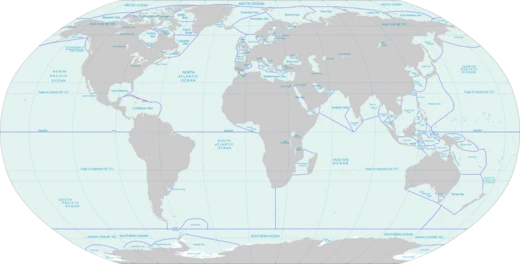
Gulf of St. Lawrence
Large Canadian gulf linking the Great Lakes to the Atlantic.

Wikipedia / Wikimedia Commons
The Gulf of St. Lawrence is a large body of water in eastern Canada that connects the Great Lakes to the Atlantic Ocean via the St. Lawrence River. It fringes the shores of five Canadian provinces—Quebec, New Brunswick, Nova Scotia, Prince Edward Island, and Newfoundland and Labrador—as well as the French islands of Saint-Pierre and Miquelon.
- Location
- Eastern Canada, fringing Quebec, New Brunswick, Nova Scotia, Prince Edward Island, Newfoundland and Labrador, and Saint-Pierre and Miquelon (France)
- Notable Islands
- Anticosti, Prince Edward, Saint Pierre, Cape Breton, Miquelon-Langlade, Îles-de-la-Madeleine
Lore & Background
The Gulf of St. Lawrence is bounded on the north by the Labrador Peninsula and Quebec, on the east by Saint-Pierre and Newfoundland, on the south by the Nova Scotia peninsula and Cape Breton Island, and on the west by the Gaspé Peninsula, New Brunswick, and Quebec. There is no consensus on the demarcation of the St. Lawrence River from the Gulf, nor whether it is hydrographically a gulf or an estuary. According to the Commission of Toponymy Quebec, the river becomes the gulf at Pointe des Monts on the Côte-Nord and Matane or Sainte-Anne-des-Monts. The International Hydrographic Organization defines the gulf's extent with specific lines from Cape Bauld to Cape St. Charles, from Cape Canso to Morgan Island, and along the meridian of 64°30'W.
Reader's Guide
The Gulf of St. Lawrence has provided a historically important marine fishery for various First Nations that lived on its shores for millennia and used its waters for transportation. Lawrence River 'The Country of Canadas'. Over the 20th century, bottom waters at the end of the channel became hypoxic. Thirteen species of cetaceans inhabit the estuary and gulf, including beluga, blue, humpback, and North Atlantic right whales. In winter, ice covers the entire gulf in January and February, aiding navigation by preventing wave formation and spray. National parks touching the gulf include Mingan Archipelago, Forillon, Prince Edward Island, Kouchibouguac, Cape Breton Highlands, and Gros Morne.
Did You Know?
- Half of Canada's ten provinces adjoin the Gulf: New Brunswick, Nova Scotia, Prince Edward Island, Newfoundland and Labrador, and Quebec.
- St. Paul Island, off Cape Breton Island, is known as the 'Graveyard of the Gulf' due to many shipwrecks.
Frequently Asked Questions
Who is Gulf of St. Lawrence?
The Gulf of St. Lawrence is a vast body of water in eastern Canada that forms the final stretch of the St. Lawrence River before it opens into the Atlantic Ocean. It borders five Canadian provinces—Quebec, New Brunswick, Nova Scotia, Prince Edward Island, and Newfoundland and Labrador—as well as the French territory of Saint-Pierre and Miquelon.
What are Gulf of St. Lawrence's powers/role?
It serves as the sole maritime gateway connecting the Great Lakes system to the open Atlantic, making it a critical shipping corridor for North American trade. The gulf also sustains some of the world's most productive marine fisheries and shelters diverse deep-water ecosystems such as the Laurentian Channel.
More in Seas And Oceans 1-24
Elsewhere in the Seas And Oceans universe
Spotted an error? Know more?
This is a living reference — every entry is fact-audited, and reader corrections feed straight into our audit queue. Suggest an edit · See this site's audit record