Indian Ocean
Third-largest ocean, warmest, key to global climate and trade.

Wikipedia / Wikimedia Commons
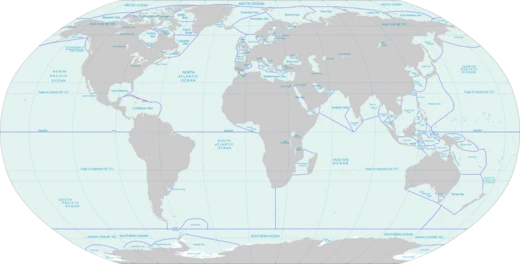
The Indian Ocean is the third-largest of the world's five oceanic divisions, covering 70,560,000 km² (27,240,000 sq mi) or approximately 20% of the water area of Earth's surface. It is bounded by Asia to the north, Africa to the west and Australia to the east. To the south it is bounded by the Southern Ocean or Antarctica, depending on the definition in use. It has large marginal or regional seas, including the Andaman Sea, the Arabian Sea, the Bay of Bengal, and the Laccadive Sea. Geologically, it is the youngest of the oceans, directly preceded by the Tethys Ocean, which fragmented into the Mediterranean Sea and the Indian Ocean only 20 million years ago. It is the warmest ocean, with a significant impact on global climate due to its interaction with the atmosphere.
- Area
- 70,560,000 km²
- Average depth
- 3,741 m
- Maximum depth
- 7,290 m
- Volume
- 264,000,000 km³
- Marginal seas
- Andaman Sea, Arabian Sea, Bay of Bengal, Laccadive Sea
- Largest rivers
- Zambezi, Ganges-Brahmaputra, Indus, Jubba, Murray
Lore & Background
The Indian Ocean has been known by its present name since at least 1515, when the Latin form Oceanus Orientalis Indicus (lit. 'Indian Eastern Ocean') is attested, named after India, which projects into it. It was earlier known as the Eastern Ocean, a term still in use during the mid-18th century, as opposed to the Western Ocean (Atlantic) before the Pacific was surmised. The modern Hindi name is हिंद महासागर (Hind Mahāsāgar; lit. 'Ocean of India'). Conversely, Chinese explorers (e.g., Zheng He during the Ming dynasty) who traveled to the Indian Ocean during the 15th century called it the Western Oceans. In Ancient Greek geography, the Indian Ocean region known to the Greeks was called the Erythraean Sea. In traditional Indian geography, the ocean is historically called the Mahodadhi (Sanskrit: महोदधि, lit. 'ocean, big sea'), divided into the two seas Purvapayodhi (Sanskrit: पूर्वपयोधि, lit. 'sunrise', referring to the Bay of Bengal) and Apara (Sanskrit: अपर, lit. 'sunset', referring to the Arabian Sea). Another name used is Ratnakara (Sanskrit: रत्नाकर, lit. 'one having jewels, mine of jewels, repository of jewels').
Reader's Guide
The Indian Ocean is ecologically diverse, with important ecosystems such as coral reefs, mangroves, and seagrass beds. It hosts a significant portion of the world's tuna catch and is home to endangered marine species. The climate around the Indian Ocean is characterized by monsoons. Its waters are affected by the Indian Ocean Walker circulation, resulting in unique oceanic currents and upwelling patterns. The Indian Ocean has been a hub of cultural and commercial exchange since ancient times. It played a key role in early human migrations and the spread of civilizations. In modern times, it remains crucial for global trade, especially in oil and hydrocarbons. Environmental and geopolitical concerns in the region include climate change, overfishing, pollution, piracy, and disputes over island territories. More than two billion people live in countries bordering the Indian Ocean. The Indian Ocean drainage basin covers 21,100,000 km² (8,100,000 sq mi), similar to that of the Pacific Ocean and half that of the Atlantic basin, or 30% of its ocean surface. The largest rivers are the Zambezi, Ganges-Brahmaputra, Indus, Jubba, and Murray rivers. After the breakup of East Gondwana and the formation of the Himalayas, the Ganges-Brahmaputra rivers flow into the world's largest delta known as the Bengal delta or Sunderbans.
Did You Know?
- The Indian Ocean is the youngest of the oceans, directly preceded by the Tethys Ocean, which fragmented into the Mediterranean Sea and the Indian Ocean only 20 million years ago.
- It is the warmest ocean, with a significant impact on global climate due to its interaction with the atmosphere.
- The Indian Ocean has been known by its present name since at least 1515, when the Latin form Oceanus Orientalis Indicus is attested.
- In Ancient Greek geography, the Indian Ocean region known to the Greeks was called the Erythraean Sea.
- The Ganges-Brahmaputra rivers flow into the world's largest delta known as the Bengal delta or Sunderbans.
Frequently Asked Questions
What is the Indian Ocean?
The Indian Ocean is the third-largest of Earth's five major oceanic divisions, spanning roughly 70.56 million square kilometres. It sits between Asia, Africa, and Australia, with the Southern Ocean or Antarctica forming its southern edge depending on which boundary definition you follow.
How big is the Indian Ocean compared to other oceans?
At about 70,560,000 km², it covers roughly 20% of all water on Earth's surface, making it the third-largest ocean after the Pacific and Atlantic. Its average depth is around 3,741 metres, with a maximum depth reaching 7,290 metres.
What are the marginal seas of the Indian Ocean?
The Indian Ocean encompasses several notable marginal seas, including the Arabian Sea, the Bay of Bengal, the Andaman Sea, and the Laccadive Sea. Major rivers such as the Ganges-Brahmaputra, Indus, Zambezi, and Murray all discharge into its waters.
Why is the Indian Ocean important for global trade?
The Indian Ocean has served as a central corridor for cultural and commercial exchange since ancient times and remains vital to modern shipping routes. A large share of the world's oil and hydrocarbon transport passes through its waters, making it indispensable to the global economy.
How does the Indian Ocean affect global climate?
As the warmest of the world's oceans, the Indian Ocean plays a major role in driving monsoon patterns and redistributing heat across the tropics. Its currents and seasonal temperature cycles influence weather systems stretching from East Africa to Southeast Asia.
More in Seas And Oceans 1-24
Related in Seas And Oceans
Links follow this subject's own source article.
Elsewhere in the Seas And Oceans universe
Spotted an error? Know more?
This is a living reference — every entry is fact-audited, and reader corrections feed straight into our audit queue. Suggest an edit · See this site's audit record