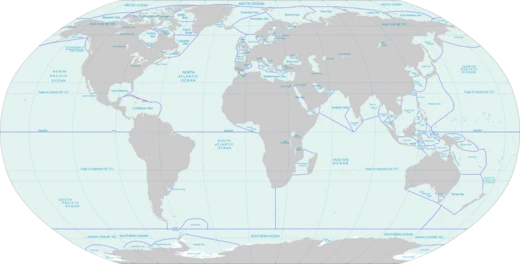
Scotia Sea
Frigid sea at the Southern Ocean's northern edge.

Wikipedia / Wikimedia Commons
The Scotia Sea is a sea located at the northern edge of the Southern Ocean at its boundary with the South Atlantic Ocean. It is bounded on the west by the Drake Passage and on the north, east, and south by the Scotia Arc, an undersea ridge and island arc system supporting various islands. The sea sits atop the Scotia Plate. It is named after the expedition ship Scotia. Many icebergs melt there.
- continental_shelf
- About half of the sea stands above the continental shelf.
Verified Timeline
Lore & Background
The Scotia Sea was named about 1932 after the Scotia, the expedition ship used in these waters by the Scottish National Antarctic Expedition (1902–1904) under William S. Bruce. The most famous traverse of this frigid sea was made near the end of the Imperial Trans-Antarctic Expedition in 1916 by Sir Ernest Shackleton and five others in the adapted lifeboat James Caird. They left Elephant Island, just off the tip of the Antarctic Peninsula, and reached South Georgia Island two weeks later. It was a distance of nearly 900 miles and the sun was only sighted for navigational fixes four times during the entire journey. In Argentina, the Scotia Sea is considered part of an area known as the Mar Argentino, and several territories claimed but not occupied by Argentina, such as South Georgia and the Falkland Islands, lie within this region.
Reader's Guide
The Scotia Sea covers an area around 900,000 km2 (347,500 sq mi). About half of the sea stands above the continental shelf. The islands bordering the sea are rocky and partly covered in ice and snow year round, but they support tundra vegetation consisting of mosses, lichens, and algae. Seabirds include four main species of albatross: black-browed albatross, grey-headed albatross, light-mantled albatross, and snowy albatross. Only five species of land birds remain on the islands, including an endemic race of the yellow-billed pintail duck and the endemic South Georgia pipit. Penguin species found here include large numbers of king penguins on South Georgia especially, as well as chinstrap penguin, macaroni penguin, gentoo penguin, Adelie penguin, and rockhopper penguin. Seals include the Antarctic fur seal and sub-Antarctic fur seal in large numbers, leopard seal, Weddell seal, the huge southern elephant seal, and crabeater seal. Although the Scotia Arc islands have a harsh climate and have never been permanently occupied, they have long been used as a base for fishing and seal hunting. Wildlife is threatened by introduced species, especially on South Georgia, where even large animals, including (now removed) reindeer, have been brought to the islands. Further damage to ecosystems results from overfishing. South Georgia, the South Sandwich Islands, and Bouvet Island are protected as nature reserves, with Bird Island, South Georgia, being a site of special scientific interest. The seals are further protected by international agreements, and fur seal populations are recovering.
Did You Know?
- The Scotia Sea was named about 1932 after the expedition ship Scotia, used by the Scottish National Antarctic Expedition (1902–1904) under William S. Bruce.
- Sir Ernest Shackleton and five others crossed the Scotia Sea in the adapted lifeboat James Caird in 1916, covering nearly 900 miles in two weeks.
- During Shackleton's traverse, the sun was only sighted for navigational fixes four times during the entire journey.
- The Scotia Sea covers an area around 900,000 km2 (347,500 sq mi).
- In Argentina, the Scotia Sea is considered part of an area known as the Mar Argentino.
Frequently Asked Questions
What is the Scotia Sea?
The Scotia Sea is a frigid body of water sitting at the northern rim of the Southern Ocean where it meets the South Atlantic. It rests directly on the Scotia Plate and takes its name from the expedition vessel Scotia.
What role does the Scotia Sea play in the ocean system?
It acts as a transitional corridor between the Southern Ocean and the South Atlantic, hemmed in by the Drake Passage to the west and the Scotia Arc—an undersea ridge and island chain—on the other three sides. It is also a major zone where drifting icebergs break apart and melt.
How does the Scotia Sea's story end?
As a permanent geographic feature it has no narrative finale, but its ongoing story is one of constant glacial interaction as icebergs dissolve in its cold waters. Most of its floor lies in deep ocean rather than on a continental shelf, with only a small portion rising above the shelf.
Why is the Scotia Sea important?
It marks the critical boundary where the Southern Ocean transitions into the South Atlantic and sits atop its own distinct tectonic plate, the Scotia Plate. The surrounding Scotia Arc supports a chain of islands, making the region both geologically and ecologically significant.
Where exactly is the Scotia Sea located?
It occupies the northern edge of the Southern Ocean, enclosed on the west by the Drake Passage and on the north, east, and south by the Scotia Arc. Think of it as a cold pocket of water nestled between Antarctica's outlying islands and the open South Atlantic.
More in Seas And Oceans 25-39
Elsewhere in the Seas And Oceans universe
Spotted an error? Know more?
This is a living reference — every entry is fact-audited, and reader corrections feed straight into our audit queue. Suggest an edit · See this site's audit record