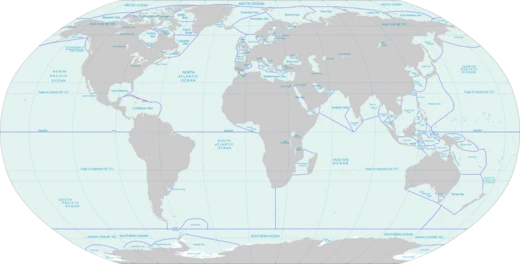
Philippine Sea
Largest sea in the world, epicenter of marine biodiversity.

Wikipedia / Wikimedia Commons
The Philippine Sea is a marginal sea of the Western Pacific Ocean east of the Philippine Archipelago and the largest sea in the world, occupying an estimated surface area of 5 million square kilometers (2×10^6 sq mi). The Philippine Sea Plate forms the floor of the sea. Its western border is the first island chain to the west, comprising the Ryukyu Islands in the northwest and Taiwan in the west. Its southwestern border comprises the Philippine islands of Luzon, Catanduanes, Samar, Leyte, and Mindanao. Its northern border comprises the Japanese islands of Honshu, Shikoku and Kyūshū. Its eastern border is the second island chain to the east, comprising the Bonin Islands and Iwo Jima in the northeast, the Mariana Islands (including Guam, Saipan, and Tinian) in the due east, and Halmahera, Palau, Yap and Ulithi (of the Caroline Islands) in the southeast. Its southern border is Indonesia's Morotai Island. The sea has a complex and diverse undersea relief, with deep sea trenches including the Mariana Trench, containing the deepest point on the planet.
- surface_area
- 5 million square kilometers (2×10^6 sq mi)
- deepest_point
- Mariana Trench (deepest point on the planet)
- marine_territorial_scope
- over 679,800 square kilometers (262,500 sq mi)
- exclusive_economic_zone
- 2.2 million km2
- first_european_to_navigate
- Ferdinand Magellan in 1521
- major_battle
- Battle of the Philippine Sea (19–20 June 1944)
Verified Timeline
Lore & Background
The first European to navigate the Philippine Sea was Ferdinand Magellan in 1521, who named it Mar Filipinas when he and his men were in the Mariana Islands prior to the exploration of the Philippines. Later it was discovered by other Spanish explorers from 1522 to 1565. A historic battle between the naval fleets of the United States and Japan took place in the vicinity of the Philippine Sea. This was called The Battle of the Philippine Sea, and occurred near the Mariana Islands from 19 to 20 June 1944. It was also the largest carrier-to-carrier battle in history which featured the United States Fifth Fleet and the 1st Mobile Fleet of the Imperial Japanese Navy. The Americans indisputably won, and nicknamed the aerial war the 'Great Marianas Turkey Shoot' due to the number of Japanese aircraft shot down. Japan struggled to recover from the severe damages of its imperial navy and air strength suffered from the battle. Typhoon Cobra, also known as 'Halsey's Typhoon,' was a tropical cyclone that struck the U.S. Pacific Third Fleet in the Philippine Sea in December 1944, resulting in the deaths of 790 sailors. In 1989, the United States Department of Defense revealed the loss of a one-megaton nuclear bomb in the Philippine Sea during the 1965 Philippine Sea A-4 incident.
Reader's Guide
The Philippine Sea has a marine territorial scope of over 679,800 square kilometers (262,500 sq mi), and an EEZ of 2.2 million km2. Attributed to an extensive vicariance and island integrations, the Philippines contains the highest number of marine species per unit area relative to the countries within the Indo-Malay-Philippines Archipelago, and has been identified as the epicenter of marine biodiversity. With its inclusion in the Coral Triangle, the Philippine Sea encompasses over 3,212 fish species, 486 coral species, 800 seaweed species, and 820 benthic algae species, wherein the Verde Island Passage is dubbed as 'the center of the center of marine fish biodiversity'. Within its territory, thirty-three endemic species of fish have been identified, including the blue-spotted angelfish (Chaetodontoplus caeruleopunctatus) and the sea catfish (Arius manillensis). The Philippine marine territory has also become a breeding and feeding ground for endangered marine species, such as the whale shark (Rhincodon typus), the dugong (Dugong dugon), and the megamouth shark (Megachasma pelagios). The Coral Triangle contains 75% of the world's coral species (around 600 species). It is home to over 2000 types of reef fish, and six of the world's seven species of marine turtles. The Philippine Sea provides or supports the livelihoods of 120 million people, and is a source of food for the Philippine coastal communities and for millions more people worldwide. Climate change is affecting the coastal ecosystem found in the Coral Triangle, contributing to rising sea levels and ocean acidification, thus endangering marine animals like fish and turtles.
Did You Know?
- The Philippine Sea is the largest sea in the world, occupying an estimated surface area of 5 million square kilometers.
- The Mariana Trench, which contains the deepest point on the planet, is located in the Philippine Sea.
- The Battle of the Philippine Sea (19–20 June 1944) was the largest carrier-to-carrier battle in history.
- The Philippine Sea encompasses over 3,212 fish species and 486 coral species, and is part of the Coral Triangle.
- Typhoon Cobra, also known as 'Halsey's Typhoon,' struck the U.S. Pacific Third Fleet in the Philippine Sea in December 1944, resulting in the deaths of 790 sailors.
More in Seas And Oceans 1-24
Related in Seas And Oceans
Links follow this subject's own source article.
Elsewhere in the Seas And Oceans universe
Spotted an error? Know more?
This is a living reference — every entry is fact-audited, and reader corrections feed straight into our audit queue. Suggest an edit · See this site's audit record