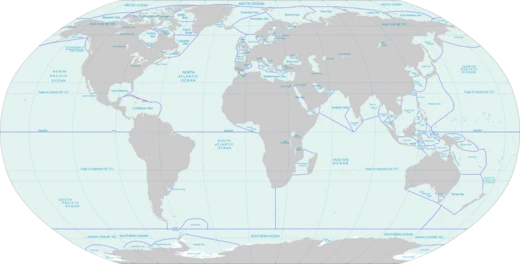
Tasman Sea
Marginal sea between Australia and New Zealand.

Wikipedia / Wikimedia Commons
The Tasman Sea is a marginal sea of the South Pacific Ocean, situated between Australia and New Zealand. It measures about 2,000 km (1,200 mi) across and about 2,800 km (1,700 mi) from north to south. The sea was named after the Dutch explorer Abel Janszoon Tasman, who in 1642 was the first known European to cross it. British explorer Lieutenant James Cook later extensively navigated the Tasman Sea in the 1770s during his three voyages of exploration.
- Area
- 2,300,000 km² (890,000 sq mi)
- Width
- 2,250 km (1,400 mi)
- Maximum depth
- 5,943 m (19,498 ft)
- Named after
- Abel Janszoon Tasman
- First European crossing
- 1642 by Abel Tasman
- Māori name
- Te Moana-a-Rehua
Verified Timeline
Lore & Background
The Māori people of New Zealand call this sea Te Moana-a-Rehua meaning 'the sea of Rehua' which clashes with the Pacific waters named Te Tai-o-Whitirea ('the sea of Whitirea') – after Whitirea, Rehua's lover – at Cape Reinga, the northernmost tip of North Island. The Tasman Sea's midocean ridge developed between 85 and 55 million years ago as Australia and Zealandia broke apart during the breakup of supercontinent Gondwana. It lies roughly midway between the continental margins of Australia and Zealandia. Much of Zealandia is submerged, so the ridge runs much closer to the Australian coast than New Zealand's.
Reader's Guide
The Tasman Sea has been a significant maritime route and ecological zone. In 1876, the first telegraph cable connecting Australia and New Zealand was laid in the Tasman Sea, later made obsolete in 1963 by the Commonwealth Pacific Cable. The sea saw early aviation attempts: Moncrieff and Hood were the first to attempt a trans-Tasman crossing by plane in January 1928, but were never seen again; the first successful flight was by Charles Kingsford Smith and Charles Ulm later that year. The first solo rowing crossing was by Colin Quincey in 1977, followed by his son Shaun Quincey in 2010. The sea is colloquially called 'The Ditch' by Australians and New Zealanders, though the exact etymology is uncertain. A deep-sea research ship, the RV Tangaroa, explored the sea and found 500 species of fish and 1300 species of invertebrates, including a tooth of a megalodon.
Did You Know?
- The Tasman Sea is about 2,000 km (1,200 mi) across and about 2,800 km (1,700 mi) from north to south.
- The Māori name Te Moana-a-Rehua means 'the sea of Rehua' and clashes with the Pacific waters named Te Tai-o-Whitirea at Cape Reinga.
- The first telegraph cable connecting Australia and New Zealand was laid in the Tasman Sea in 1876.
- Moncrieff and Hood attempted the first trans-Tasman flight in January 1928 but were never seen again.
- The RV Tangaroa found 500 species of fish and 1300 species of invertebrates in the sea, including a megalodon tooth.
Frequently Asked Questions
Who is Tasman Sea?
The Tasman Sea is a marginal sea of the South Pacific Ocean tucked between the coastlines of Australia and New Zealand. It carries the name of Dutch navigator Abel Janszoon Tasman, who in 1642 became the first known European to sail across its waters.
Where does Tasman Sea sit on the ocean map?
It occupies the stretch of South Pacific bounded by Australia's eastern seaboard to the west and New Zealand's western shores to the east, spanning roughly 2,250 km in width and about 2,800 km from north to south. In Māori, the same body of water is called Te Moana-a-Rehua.
What are Tasman Sea's key stats?
The sea covers approximately 2.3 million square kilometres and reaches a maximum depth of 5,943 metres. Those figures make it one of the deeper marginal seas in the Pacific basin.
Who first crossed Tasman Sea and when?
Abel Janszoon Tasman, sailing under the Dutch East India Company, completed the first recorded European crossing in 1642. Over a century later, Lieutenant James Cook charted the sea extensively during his three voyages of exploration in the 1770s.
Why is Tasman Sea important?
It acts as the primary maritime corridor linking Australia and New Zealand, shaping trade routes, migration paths, and shared marine ecosystems between the two nations. Its status as a distinct marginal sea also gives it a unique role in South Pacific oceanography and biodiversity.
More in Seas And Oceans 25-39
Elsewhere in the Seas And Oceans universe
Spotted an error? Know more?
This is a living reference — every entry is fact-audited, and reader corrections feed straight into our audit queue. Suggest an edit · See this site's audit record