Greenland Sea
Arctic sea with complex currents, ice, and historical whaling.

Wikipedia / Wikimedia Commons
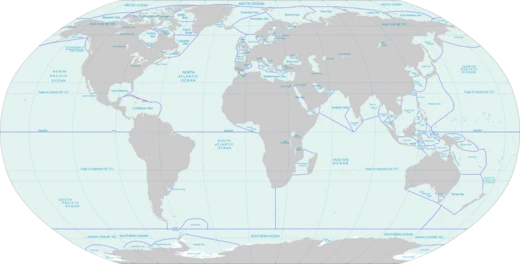
The Greenland Sea (Danish: Grønlandshavet) is a body of water that borders Greenland to the west, the Svalbard archipelago to the east, Fram Strait and the Arctic Ocean to the north, and the Norwegian Sea and Iceland to the south. The Greenland Sea is often defined as part of the Arctic Ocean, sometimes as part of the Atlantic Ocean. However, definitions of the Arctic Ocean and its seas tend to be imprecise or arbitrary. In general usage, the term 'Arctic Ocean' would exclude the Greenland Sea. In oceanographic studies, the Greenland Sea is considered part of the Nordic Seas, along with the Norwegian Sea. In oceanography, the Arctic Ocean and Nordic Seas are often referred to collectively as the 'Arctic Mediterranean Sea', a marginal sea of the Atlantic.
- Deepest point
- Depths down to 5,570 m (18,270 ft) have been measured in the Molloy Deep of the
Verified Timeline
Lore & Background
The Greenland Sea has been known for millennia, but its first scientific explorations were conducted in 1765 and 1766 as part of two Russian government expeditions under the command of Admiral V. Chichagov. In search of a passage north of Greenland through the Arctic, they carried out oceanographic, geophysical and meteorological observations according to a special program developed by M. Lomonosov, studied currents and ice drift in the northern Greenland Sea, took soil samples, and measured depths in many places. A number of scientific investigations were carried out in 1876–1878 as part of the Norwegian North-Atlantic Expedition. Since then, many countries, mostly Norway, Iceland and Russia have sent scientific expeditions to the area. The complex water current system in the Greenland Sea was described in 1909 by Fridtjof Nansen.
Reader's Guide
The Greenland Sea was a popular hunting ground for the whaling industry for 300 years, until 1911, primarily based in Spitsbergen. At that point, the formerly rich whale population here was so depleted that the industry was no longer profitable. The remaining whales of the Greenland Sea have been protected ever since, but the populations have not shown any proof of significant regeneration. Since the late 1990s, polar biologists report an increase in the local bowhead whale population and in 2015, arctic scientists discovered a surprising abundance of them in a small area. These results may be interpreted as an early sign of a beginning recovery for this particular species, that once formed the largest bowhead population in the world, at an estimated 52,000 whales. The Inuit hunted whales on a non-industrial scale in the Greenland Sea since the 15th century, as evidenced by archaeology. The first complete man-powered crossing of the Greenland Sea was achieved in 2017 by rowing expedition, Polar Row led by Fiann Paul.
Did You Know?
- The Odden ice tongue extended eastward from the main East Greenland ice edge in the vicinity of 72–74°N during the winter and acted as a key winter ice formation area in the Arctic.
- The West Ice, which forms in winter in the Greenland Sea north of Iceland between Greenland and Jan Mayen island, is a major breeding ground of harp seal and hooded seal that has been used for seal hunting for more than 200 years.
- Around 5 April 1952, a major storm resulted in the disappearance of ships with 79 Norwegian seal hunters on board; seven other Norwegian seal hunting vessels shipwrecked the same month.
- The Greenland Sea was a popular hunting ground for the whaling industry for 300 years, until 1911, when the formerly rich whale population was so depleted that the industry was no longer profitable.
- The first complete man-powered crossing of the Greenland Sea was achieved in 2017 by rowing expedition Polar Row led by Fiann Paul.
Frequently Asked Questions
Who is Greenland Sea?
The Greenland Sea is a marginal body of water nestled between Greenland to the west, Svalbard to the east, Fram Strait and the Arctic Ocean to the north, and the Norwegian Sea and Iceland to the south. It is most commonly grouped with the Nordic Seas and occasionally lumped together with the Arctic Ocean under the label 'Arctic Mediterranean Sea,' a marginal sea of the Atlantic.
What are Greenland Sea's powers/role?
It functions as a critical mixing zone where cold Arctic outflow meets warmer Atlantic inflow, helping drive the planet's thermohaline circulation. Its waters are shaped by complex currents, shifting sea-ice cover, and a long history of whaling activity along its coasts.
How does Greenland Sea's story end?
Rather than closing on a single note, its waters flow southward into the Norwegian Sea and eventually feed the broader Atlantic system. To the north it links directly through Fram Strait into the Arctic Ocean, making it a perpetual transitional passage between two major basins.
Why is Greenland Sea important?
Because it is a primary convergence point for Arctic and Atlantic water masses, it plays a outsized role in global heat distribution and climate regulation. Its basin also contains the Molloy Deep, which reaches roughly 5,550–5,607 m, making it one of the deepest stretches in the region.
Where does Greenland Sea live?
It occupies the waters along Greenland's eastern flank, stretching north to Fram Strait and south toward Iceland and the Norwegian Sea. Its exact borders are often drawn imprecisely, with different authorities assigning it to either the Arctic or the Atlantic depending on the context.
More in Seas And Oceans 1-24
Related in Seas And Oceans
Links follow this subject's own source article.
Elsewhere in the Seas And Oceans universe
Spotted an error? Know more?
This is a living reference — every entry is fact-audited, and reader corrections feed straight into our audit queue. Suggest an edit · See this site's audit record