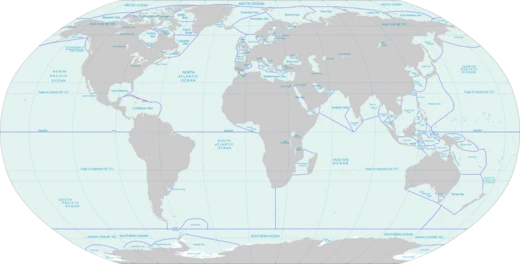
Southern Ocean
Southernmost ocean encircling Antarctica, defined by circulation and latitude.

Wikipedia / Wikimedia Commons
The Southern Ocean, also known as the Antarctic Ocean, comprises the southernmost waters of the World Ocean, generally taken to be south of 60° S latitude and encircling Antarctica. With a size of 21,960,000 km² (8,480,000 mi²), it is the second-smallest of the five principal oceanic divisions, smaller than the Pacific, Atlantic and Indian oceans, and larger than the Arctic Ocean. Its definition and boundaries have been subject to long-standing debate among geographers and international organizations, with the IHO including the ocean and its definition as the waters south of the 60th parallel south in its 2000 revisions, though this has not been formally adopted due to continuing impasses about some content.
- size
- 21,960,000 km² (8,480,000 mi²)
- rank
- second-smallest of five principal oceanic divisions
- maximum_depth
- 7,434 metres (24,390 ft)
- deepest_point
- Factorian Deep at 60° 28' 46"S, 025° 32' 32"W
- deepest_point_discovered_by
- Five Deeps Expedition, February 2019
- northern_limit_definition
- south of 60° S latitude (IHO 2000 draft) or seasonally fluctuating Antarctic Con
Verified Timeline
Lore & Background
The Southern Ocean was first delineated by land-based limits in the 1928 first edition of Limits of Oceans and Seas, extending from Antarctica northward to South America, Africa, Australia, and Broughton Island, New Zealand. In the 1937 second edition, its northern limits were moved southward to latitudes 40°S between Cape Agulhas in Africa and Cape Leeuwin in Western Australia, and to latitude 55°S between Auckland Island of New Zealand and Cape Horn in South America. However, the 1953 third edition omitted the Southern Ocean entirely, with a note stating that 'the majority of opinions received since the issue of the 2nd Edition in 1937 are to the effect that there exists no real justification for applying the term Ocean to this body of water, the northern limits of which are difficult to lay down owing to their seasonal change.' The Atlantic, Pacific, and Indian Oceans were therefore extended south to the Antarctic Continent. The IHO readdressed the question in a survey in 2000, where 28 of 68 member nations responded, and all except Argentina agreed to redefine the ocean. The proposal for the name Southern Ocean won 18 votes, beating the alternative Antarctic Ocean. Half of the votes supported a definition at the 60th parallel south, with other votes for definitions as far north as the 35th parallel south. The National Geographic Society recognized the ocean officially in June 2021.
Reader's Guide
The Southern Ocean's significance lies in its role in global climate and ocean circulation. Its overturning circulation makes up the second half of the global thermohaline circulation, after the better known Atlantic meridional overturning circulation (AMOC). Much like AMOC, it has been substantially affected by climate change, in ways that have increased ocean stratification, and which may also result in the circulation substantially slowing or even passing a tipping point and collapsing outright. The latter would have adverse impacts on global weather and the function of marine ecosystems here, unfolding over centuries. The ongoing warming is already changing marine ecosystems here. The ocean's maximum depth was surveyed by the Five Deeps Expedition in early February 2019, whose multibeam sonar team identified the deepest point at 60° 28' 46"S, 025° 32' 32"W, with a depth of 7,434 metres (24,390 ft). Expedition leader Victor Vescovo proposed naming this deepest point the 'Factorian Deep', based on the name of the crewed submersible DSV Limiting Factor, in which he successfully visited the bottom for the first time on February 3, 2019.
Did You Know?
- The Southern Ocean was omitted from the IHO's 1953 third edition of Limits of Oceans and Seas, with a note stating most opinions held there was no real justification for applying the term 'Ocean' to this body of water.
- The deepest point, Factorian Deep, was visited for the first time on February 3, 2019, by Victor Vescovo in the crewed submersible DSV Limiting Factor.
- In the IHO's 2000 survey, 28 of 68 member nations responded, and all except Argentina agreed to redefine the Southern Ocean.
- The Southern Ocean overturning circulation makes up the second half of the global thermohaline circulation, after the Atlantic meridional overturning circulation (AMOC).
- The National Geographic Society officially recognized the Southern Ocean in June 2021; prior to this, it depicted it in a different typeface on its maps.
Frequently Asked Questions
Who is the Southern Ocean?
The Southern Ocean is the circumpolar body of water that wraps entirely around Antarctica, typically defined as all waters south of 60° S latitude. It is the second-smallest of the five principal oceanic divisions, covering roughly 21.96 million square kilometres.
What makes the Southern Ocean unique compared to the other four oceans?
Unlike the other divisions, it has no land borders and is instead delineated by the seasonally shifting Antarctic Convergence and its surrounding circulation. Its maximum depth of 7,434 metres, found at the Factorian Deep, was first confirmed by the Five Deeps Expedition in February 2019.
Where is the deepest point in the Southern Ocean?
The Factorian Deep sits at approximately 60° 29' S, 25° 33' W and plunges to 7,434 metres (24,390 ft) below the surface. It was identified and sounded by the Five Deeps Expedition in early 2019.
Why has the Southern Ocean's boundary been so controversial?
Because it encircles a continent with no fixed coastline, geographers and the International Hydrographic Organization have long debated whether its northern edge should follow the 60° S line or the fluctuating Antarctic Convergence. This unresolved definition has kept the ocean's exact size and scope in flux for decades.
Why is the Southern Ocean important to global oceanography?
As the only ocean defined by a current system rather than continental boundaries, it acts as a critical conveyor belt linking the Atlantic, Pacific, and Indian Oceans. Its relatively modest area belies a disproportionate influence on worldwide climate regulation and marine biodiversity.
More in Seas And Oceans 25-39
Related in Seas And Oceans
Links follow this subject's own source article.
Elsewhere in the Seas And Oceans universe
Spotted an error? Know more?
This is a living reference — every entry is fact-audited, and reader corrections feed straight into our audit queue. Suggest an edit · See this site's audit record