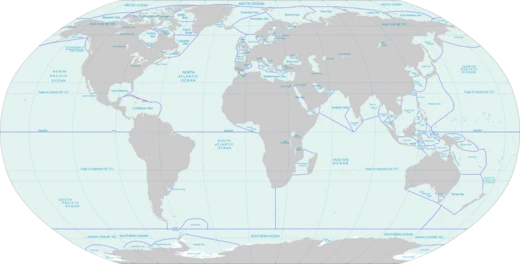
Sea of Okhotsk
Coldest sea in East Asia, seasonally ice-covered.

Wikipedia / Wikimedia Commons
The Sea of Okhotsk is a marginal sea of the northwestern Pacific Ocean, located between Russia's Kamchatka Peninsula, the Kuril Islands, Japan's island of Hokkaido, the island of Sakhalin, and the eastern Siberian coast. It is named for the port of Okhotsk, itself named for the Okhota River. The sea is significant as the coldest sea in East Asia and the southernmost sea in the Northern Hemisphere that freezes over seasonally, with winter conditions in its northern and western reaches approaching those of the Arctic.
- location
- Northwestern Pacific Ocean, between Russia and Japan
- coldest_months
- January and February
- warmest_months
- July and August
- notable_feature
- Cold intermediate (dicothermal) layer with core near -2°C (28°F)
Lore & Background
It is connected to the Sea of Japan on either side of Sakhalin: through the Sakhalin Gulf and Gulf of Tartary on the west, and through the La Pérouse Strait on the south. In winter, navigation is impeded by ice floes, which form due to large amounts of freshwater from the Amur River lowering salinity and raising the freezing point. Cold air from Siberia forms sea ice in the northwestern sea, and as ice forms it expels salt into deeper layers, creating dense water that flows east toward the Pacific, carrying oxygen and nutrients that support abundant sea life.
Reader's Guide
The Sea of Okhotsk has warmed in some places by as much as 3°C since preindustrial times, three times faster than the global mean, which inhibits sea ice formation and drives fish populations north. The salmon catch on the northern Japanese coast has fallen 70% in the last 15 years, while the Russian chum salmon catch has quadrupled. The sea's circulation is cyclonic (counter-clockwise), with three dominant currents: the warm West Kamchatka Current, the cold East Sakhalin Current, and the warm Soya Current. The sea is surrounded on all sides by territory administered by the Russian Federation except Hokkaido, and Japan claims the southern Kuril Islands, referring to them as Northern Territories. The sea's islands include Hokkaido, Sakhalin, the Shantar Islands, the Kuril Islands, and Iony Island, the only island in open waters.
Did You Know?
- The Sea of Okhotsk is the southernmost sea in the Northern Hemisphere that freezes over seasonally.
- Ice floes form due to large amounts of freshwater from the Amur River lowering salinity and raising the freezing point.
- The sea has warmed in some places by as much as 3°C since preindustrial times, three times faster than the global mean.
- The salmon catch on the northern Japanese coast has fallen 70% in the last 15 years, while the Russian chum salmon catch has quadrupled.
Frequently Asked Questions
Who is Sea of Okhotsk?
The Sea of Okhotsk is a marginal sea sitting in the northwestern corner of the Pacific, hemmed in by Kamchatka, the Kuril chain, Hokkaido, Sakhalin, and the Siberian mainland. It borrows its name from the old port of Okhotsk, which itself was named after the Okhota River.
What are Sea of Okhotsk's powers/role?
Its signature trait is holding the title of East Asia's coldest sea while also being the southernmost Northern Hemisphere sea that locks up under seasonal ice. In the northern and western basins, winter temperatures and ice conditions come close to what you would see deep in the Arctic.
How does Sea of Okhotsk's story end?
Because it is a permanent oceanic basin rather than a narrative character, it has no plot resolution; its cycle simply repeats as the January–February ice pack thaws into the July–August warmth. Geologically, the sea continues to exist as a fixed feature of the northwestern Pacific.
What is Sea of Okhotsk's origin?
The name traces back to the Okhota River and the settlement that grew along its mouth on the eastern Siberian shore, and cartographers eventually applied that to the entire enclosed basin. The basin itself is a product of long-term tectonic rifting and seafloor evolution in the northwestern Pacific.
More in Seas And Oceans 25-39
Elsewhere in the Seas And Oceans universe
Spotted an error? Know more?
This is a living reference — every entry is fact-audited, and reader corrections feed straight into our audit queue. Suggest an edit · See this site's audit record