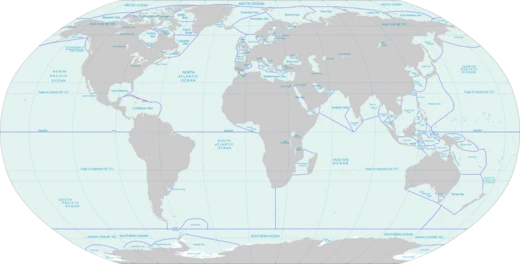
Gulf of Thailand
Shallow inlet between Southeast Asia and the Malay Peninsula.

Wikipedia / Wikimedia Commons
The Gulf of Thailand, historically known as the Gulf of Siam, is a shallow inlet adjacent to the southwestern South China Sea, bounded between the southwestern shores of Mainland Southeast Asia and the northern half of the Malay Peninsula. The gulf is surrounded on the north, west and southwest by the coastline of Thailand; on the northeast by Cambodia; and the Mekong Delta region of Vietnam, opening to the South China Sea in the southeast.
- coastline_percentage_Thai
- 70%
- official_name_adopted_by
- International Hydrographic Organization
Lore & Background
The Gulf of Thailand, originally called the Gulf of Siam, derives its name from the historical kingdom of Siam, the former name of modern-day Thailand. Siam itself is an exonym, believed to have origins in the Sanskrit word śyāma, meaning 'dark' or 'brown', referring to the skin tone of the region's inhabitants. The gulf is generally identified with the Great Gulf (Latin: Magnus Sinus) known to Greek, Roman, Arab, Persian, and Renaissance cartographers before the 16th century. It was a large paleolake with a major paleo-river system in Sundaland, filled with fresh water from rivers and rain. The principal water source regions were the Eastern Malay Peninsula and the Chao Phraya Basin. The gulf is relatively shallow, with a mean depth of 58 metres and maximum depth of 85 metres, making water exchange slow. Strong water inflow from rivers reduces salinity and enriches sediments. The main rivers emptying into the gulf include the Chao Phraya, Mae Klong, Bang Pakong, and Tapi River. The seabed morphology in the central depression features elongated mounds and ridges, reflecting interaction between sediment dewatering and erosional activity of bottom currents.
Reader's Guide
The Gulf of Thailand is significant as the largest gulf in Southeast Asia, bordered by Thailand, Cambodia, Malaysia, and Vietnam. It has been a crucial maritime region historically, identified with the Great Gulf known to ancient and Renaissance cartographers. Its shallow depth and slow water exchange create unique environmental conditions, including low salinity and sediment enrichment from river inflows. The gulf supports important fisheries, with 41 percent of Thailand's total marine catch taken from its waters. The gulf's paleolake history during the Last Glacial Maximum provides important geological context for understanding Sundaland's submergence.
Did You Know?
- The Gulf of Thailand was originally called the Gulf of Siam, named after the historical kingdom of Siam.
- The gulf has a mean depth of only 58 metres and a maximum depth of 85 metres.
- Around 70% of the gulf's coastline belongs to Thailand.
Frequently Asked Questions
What are Gulf of Thailand's powers/role?
The gulf acts as a shallow maritime corridor with a mean depth of just 58 meters and a maximum of 85 meters, shaping the kinds of shipping, fisheries, and marine life it can support. Its limited depth and enclosed geography make it a distinct transitional zone rather than an open-ocean environment.
How does Gulf of Thailand's story end?
The gulf's waters flow southeastward past the Mekong Delta region of Vietnam before opening directly into the South China Sea. This southeastern outlet marks the point where the enclosed gulf transitions into the broader ocean basin.
Why is Gulf of Thailand important?
Roughly 70 percent of the gulf's coastline belongs to Thailand, anchoring the country's maritime trade, offshore energy, and coastal fisheries. It simultaneously borders Cambodia to the northeast and Vietnam near the Mekong Delta, tying three nations' economies to a shared shallow-water ecosystem.
What are Gulf of Thailand's key relationships?
The gulf is flanked on the north, west, and southwest by Thailand's shores, on the northeast by Cambodia, and near the Mekong Delta by Vietnam. Its southeastern opening links it directly to the South China Sea, positioning it as a geographical bridge between the mainland coast and the open Pacific-margin ocean.
More in Seas And Oceans 1-24
Elsewhere in the Seas And Oceans universe
Spotted an error? Know more?
This is a living reference — every entry is fact-audited, and reader corrections feed straight into our audit queue. Suggest an edit · See this site's audit record