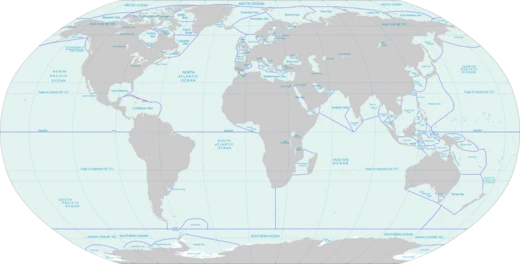
Gulf of Mexico
Marginal sea of the Atlantic, bordered by the U.S., Mexico, and Cuba.

Wikipedia / Wikimedia Commons
The Gulf of Mexico is an oceanic basin and a marginal sea of the Atlantic Ocean, mostly surrounded by the North American continent. It is bounded by the Gulf Coast of the United States, Mexican states, and Cuba, and is one of the largest offshore petroleum production regions in the world.
- Maximum depth
- not specified
- Countries bordering
- United States, Mexico, Cuba
- Named after
- Mexica (Aztec) people
Lore & Background
Before the late Triassic, the area was dry land within the supercontinent Pangaea. The basin consists of sedimentary rocks and recent sediments, with a roughly oval shape. Historically, the gulf was known by various names. The Aztecs called it Chalchiuhtlicueyecatl ('House of Chalchiuhtlicue') and ilhuicaatl ('sky water'). The Maya likely called it nahá ('great water'). European maps initially left it unlabeled; Hernán Cortés called it 'Sea of the North'. president Donald Trump directed federal agencies to rename it 'Gulf of America', which stoked controversy.
Reader's Guide
The Gulf of Mexico is significant as a major oceanic basin and marginal sea that influences weather across the United States, including severe weather in Tornado Alley. It is a key region for offshore petroleum production, making up 14% of U.S. crude oil output. The gulf's relatively narrow connections to the Atlantic Ocean result in very small tidal ranges. Its name has historical and cultural roots, tied to the Mexica (Aztec) people, and has been officially recognized by the International Hydrographic Organization. president sparked debate, with a poll showing 71% of U.S. respondents opposing the change.
Did You Know?
- The Gulf of Mexico is connected to the Atlantic Ocean through the Straits of Florida and to the Caribbean Sea via the Yucatán Channel.
- In Aztec religion, the gulf was called Chalchiuhtlicueyecatl, after the deity of the seas.
Frequently Asked Questions
Who is Gulf of Mexico?
The Gulf of Mexico is a large oceanic basin that acts as a marginal sea of the Atlantic Ocean, tucked almost entirely within the North American continent. It is ringed by the U.S. Gulf Coast, several Mexican states, and the island of Cuba.
What are Gulf of Mexico's powers/role?
It operates as one of the planet's most productive offshore petroleum regions, anchoring a huge share of the global energy supply. Its waters also carry major commercial shipping lanes and sustain rich marine ecosystems.
How does Gulf of Mexico's story end?
Because it is a permanent geographic feature rather than a narrative character, it has no true ending; its ongoing significance as an economic, ecological, and strategic zone ensures it stays central to U.S., Mexican, and Cuban life. Its long-term trajectory will be shaped by continued energy extraction, shifting climate patterns, and conservation policy.
What's Gulf of Mexico's backstory/origin?
Its name ultimately derives from the Mexica (Aztec) people, whose designation was later applied to the broader region. Geologically, it formed as a basin carved into the North American plate and has since become a defining feature of the continent's southern coastline.
More in Seas And Oceans 1-24
Elsewhere in the Seas And Oceans universe
Spotted an error? Know more?
This is a living reference — every entry is fact-audited, and reader corrections feed straight into our audit queue. Suggest an edit · See this site's audit record