Gulf of Alaska
Arm of the Pacific Ocean off southern Alaska, storm generator.

Wikipedia / Wikimedia Commons
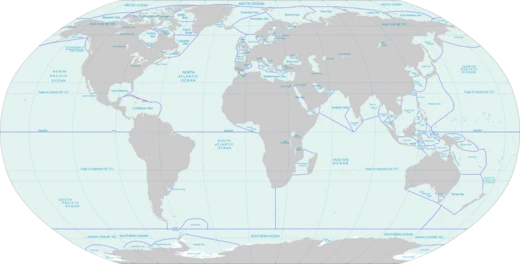
The Gulf of Alaska (Tlingit: Yéil T'ooch’) is an arm of the Pacific Ocean defined by the curve of the southern coast of Alaska, stretching from the Alaska Peninsula and Kodiak Island in the west to Cape Spencer in the east. It is a Class I, productive ecosystem and a major generator of storms that affect the Pacific coast of North America.
- ice_status
- Coastal areas and inlets can experience sea ice in winter, though the open gulf is moderated by the Alaska Current.
Lore & Background
The Gulf of Alaska is an arm of the Pacific Ocean defined by the curve of the southern coast of Alaska, stretching from the Alaska Peninsula and Kodiak Island in the west to Cape Spencer in the east, where Glacier Bay is found and the Inside Passage begins. Its shoreline is a combination of forest, mountain, and tidewater glaciers, including Alaska's largest glaciers, the Malaspina Glacier and Bering Glacier. The coast is heavily indented with Cook Inlet and Prince William Sound, the two largest connected bodies of water, and includes Yakutat Bay. Lituya Bay, a fjord north of Cross Sound and south of Mount Fairweather, is the site of the largest recorded tsunami in history and serves as a sheltered anchorage for fishing boats.
Reader's Guide
Due to the North Pacific Current, fed by the warm Kuroshio Current, the Gulf remains ice-free throughout the year. The Gulf is a great generator of storms, dumping vast quantities of snow and ice on southern Alaska and moving storms south along the coasts of British Columbia, Washington, Oregon, and as far as Southern California, especially during El Niño events. Much of the seasonal rainfall and snowfall in the Pacific Northwest and Southwestern United States comes from the Gulf of Alaska.
Did You Know?
- While the open gulf is moderated by the Alaska Current, coastal areas and inlets can experience sea ice in winter.
Frequently Asked Questions
Who is Gulf of Alaska?
Gulf of Alaska is a broad stretch of water hugging the southern coastline of Alaska, stretching from the Alaska Peninsula and Kodiak Island in the west to Cape Spencer in the east. It goes by the Tlingit name Yéil T'ooch' and is best understood as a defined arm branching off the larger Pacific Ocean.
What are Gulf of Alaska's powers or role?
The gulf functions as a major storm engine, regularly generating weather systems that sweep along the Pacific coast of North America. It also sustains a Class I productive marine ecosystem, making it one of the most biologically rich feeding areas in the northern Pacific.
How does Gulf of Alaska's story end?
Because the gulf is a permanent geographic feature rather than a narrative character, it has no true 'ending'; it simply cycles through seasons indefinitely. In winter, sheltered inlets and coastal areas can freeze, while the open gulf waters stay liquid thanks to the moderating influence of the Alaska Current.
Why is Gulf of Alaska important?
The gulf shapes weather patterns across western North America by acting as a persistent source of coastal storms. Its highly productive waters also anchor commercial fisheries and support diverse marine communities, giving it outsized ecological and economic significance for the region.
Where does Gulf of Alaska sit in the Seas And Oceans catalog?
Gulf of Alaska is listed as entry 1-24 in the Seas And Oceans lineup, classified as a Pacific Ocean arm rather than a fully enclosed sea. Its identity is defined entirely by the curved southern shoreline of Alaska, which sets it apart from the open ocean to the south.
More in Seas And Oceans 1-24
Elsewhere in the Seas And Oceans universe
Spotted an error? Know more?
This is a living reference — every entry is fact-audited, and reader corrections feed straight into our audit queue. Suggest an edit · See this site's audit record